
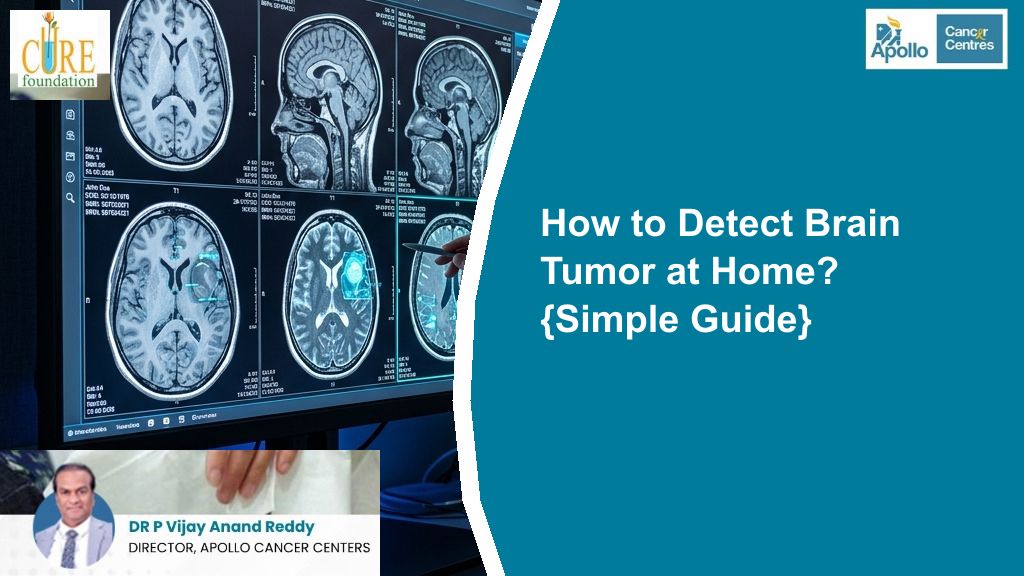
How to Detect Brain Tumor at Home? {Simple Guide}
Dr. Vijay Anand Reddy
Consultant Oncologist • AI-Assisted Educational Resource
Medical Disclaimer: This article is AI-assisted and intended for general informational purposes only. It does not replace professional medical advice, diagnosis, or treatment. Please consult a qualified healthcare specialist for advice specific to your condition.
Direct Answer (AEO Summary): How to Detect Brain Tumor at Home?
A brain tumor cannot be definitively diagnosed or tested at home, but early neurological warning signs can be observed and tracked. Home detection refers to recognizing progressive neurological changes—such as persistent morning headaches that worsen with coughing, unexplained nausea/vomiting, sudden seizures, blurred or double vision, speech slurring, memory loss, and one-sided limb weakness.
If you observe persistent or worsening neurological symptoms for more than 2 weeks, consult a leading neuro-oncology specialist such as Dr. Vijay Anand Reddy immediately. Definitive diagnosis requires medical imaging like a contrast-enhanced MRI Scan or CT Scan at specialized centers providing Brain Tumor Treatment in Hyderabad.
Table of Contents
- Understanding Brain Tumors & Primary vs. Secondary Types
- Can You Detect a Brain Tumor at Home? (Medical Boundaries)
- RED ALERT: Emergency Symptoms Requiring Immediate Care
- Brain Lobe Localization Guide (Symptom-to-Lobe Matrix)
- Common Signs of a Brain Tumor Noticeable at Home
- How to Maintain a Structured Symptom Tracking Diary
- Medical Diagnostic Tests Used to Confirm a Brain Tumor
- Differentiating Stress & Migraines from Brain Tumor Symptoms
- Conclusion & Specialist Care
- Frequently Asked Questions (FAQs)
Understanding Brain Tumors & Primary vs. Secondary Types
A Brain Tumor is an abnormal mass of proliferating cells within the cranium or central spinal canal. Because the rigid skull has a fixed volume, any growing mass increases intracranial pressure (ICP) and compresses delicate neural tissue.
Brain tumors fall into two main categories evaluated at our Neuro-Oncology Clinic:
- Primary Brain Tumors: Originate directly within brain tissue or surrounding membranes (e.g., Meningioma, Astrocytoma, or aggressive Glioblastoma Multiforme).
- Secondary (Metastatic) Brain Tumors: Originate in another organ (such as lung, breast, melanoma, or kidney) and spread to the brain via the bloodstream.
Can You Detect a Brain Tumor at Home? (Medical Boundaries)
It is essential to understand the distinction between symptom observation at home and medical diagnosis:
What You CAN Do at Home:
- Observe subtle shifts in mood, memory, speech, or motor coordination.
- Track headache frequency, timing (e.g., waking up with headaches), and severity.
- Log neurological episodes like involuntary muscle twitching or brief disorientation.
What You CANNOT Do at Home:
- Confirm tumor presence, size, or histological grade (benign vs. malignant).
- Differentiate a brain tumor from stroke, brain aneurysm, or encephalitis without an MRI scan.
RED ALERT: Emergency Symptoms Requiring Immediate Medical Attention
Do not wait or rely on home monitoring if any of the following emergency signs occur. Go to the nearest emergency room immediately:
- A first-time Seizure or convulsion in an adult with no prior history.
- Sudden "thunderclap" headache reaching maximum intensity in seconds.
- Sudden weakness, numbness, or paralysis on one side of the face or body.
- Explosive projectile vomiting without nausea, accompanied by severe confusion.
- Sudden loss of consciousness or severe lethargy where the person cannot be awakened.
Brain Lobe Localization Guide (Symptom-to-Lobe Matrix)
The specific symptoms noticed at home often depend on which region of the brain is compressed by the tumor:
Frontal Lobe
Controls personality, decision-making, and motor control. Tumor signs: Marked personality changes, loss of social inhibition, weakness in arm/leg.
Temporal Lobe
Controls memory, hearing, and language comprehension. Tumor signs: Short-term memory loss, seizures with strange smells, difficulty understanding spoken words.
Parietal Lobe
Processes sensory touch and spatial orientation. Tumor signs: Numbness, inability to distinguish left from right, difficulty reading or writing.
Occipital Lobe & Cerebellum
Controls vision, balance, and coordination. Tumor signs: Blind spots, visual hallucinations, unsteadiness while walking, dizziness/vertigo.
Common Signs of a Brain Tumor Noticeable at Home
Persistent & Progressive Morning Headaches
Unlike tension headaches or migraines, brain tumor headaches are typically most severe upon waking in the morning (due to blood pooling in the brain overnight). They steadily worsen over weeks and intensify when coughing, sneezing, or bending over.
Unexplained Morning Nausea & Projectile Vomiting
Vomiting caused by elevated intracranial pressure often occurs suddenly in the morning, sometimes without prior feeling of stomach nausea or illness.
Progressive Vision & Hearing Disturbances
Blurred vision, double vision (diplopia), loss of peripheral vision (bumping into doorframes), or sudden ringing/hearing loss in one ear.
Seizures, Fits, or Involuntary Twitching
Seizures are one of the most common early warning signs of brain tumors in adults. They can range from full convulsions to sudden staring spells or localized facial twitching.
One-Sided Limb Weakness or Numbness
Feeling clumsiness, weakness, or tingling in one arm or leg, dropping cups frequently, or dragging one foot while walking.
Speech Slurring & Language Difficulty
Struggling to find common words, slurring speech, or failing to understand simple instructions spoken by family members.
Personality & Behavioral Changes
Family members may notice an energetic person becoming apathy-ridden, unusually irritable, anxious, or making impulsive choices.
Persistent Cognitive Confusion & Memory Loss
Difficulty performing routine tasks (like managing finances or cooking familiar recipes) and forgetting recent events.
How to Maintain a Structured Symptom Tracking Diary
If you suspect unusual symptoms, maintain a detailed symptom log for 1 to 2 weeks before your appointment:
| Date & Time | Symptom Description | Severity (1 to 10) | Triggers or Context |
|---|---|---|---|
| Oct 12, 7:00 AM | Dull, throbbing morning headache & nausea | 7 / 10 | Woke up with headache; worsened after coughing. |
| Oct 14, 2:30 PM | Right arm numbness & dropped coffee mug | 6 / 10 | Lasted 15 minutes during desk work. |
Medical Diagnostic Tests Used to Confirm a Brain Tumor
Once you present your home tracking log to a specialist, medical confirmation involves state-of-the-art diagnostic imaging available at our Brain Tumor Clinic:
- Contrast-Enhanced MRI Scan: The gold standard imaging modality for visualizing brain tissue, tumor boundaries, and edema.
- CT Scan (Computed Tomography): Rapid imaging to detect intracranial hemorrhage, bone involvement, or calcification.
- MR Spectroscopy & Functional MRI (fMRI): Maps eloquent speech and motor pathways around the tumor prior to surgery or Stereotactic Radiosurgery (SRS).
- Biopsy: Surgical tissue sampling to confirm exact tumor histology and molecular markers.
Differentiating Stress & Migraines from Brain Tumor Symptoms
- Stress & Tension Headaches: Cause band-like tightness around both sides of the head. They do NOT cause seizures, projectile morning vomiting, or one-sided body paralysis.
- Migraines: Often accompanied by aura, light sensitivity, and severe throbbing, but usually respond to migraine medication and subside within 24 to 72 hours without progressive neurological deficits.
- Brain Tumor Symptoms: Are persistent, progressive over weeks, and accompanied by neurological focal deficits.
Conclusion & Specialist Care
Learning how to detect early warning signs of a brain tumor at home empowers you to take prompt medical action. While home tracking cannot replace an MRI scan, early awareness of neurological changes plays a pivotal role in achieving successful treatment outcomes.
If you or a loved one is experiencing persistent morning headaches, seizures, or unexplained neurological deficits, consult Dr. Vijay Anand Reddy, leading Radiation Oncologist and Director of Apollo Cancer Centre Hyderabad, for expert diagnostic scans and advanced treatment options including radiation oncology and stereotactic radiosurgery. Read more about the importance of early detection in brain tumors and expert tips on brain tumor prevention.
Frequently Asked Questions (FAQs)
Can I do a self-test at home to check for a brain tumor?
No reliable self-test or home kit exists to diagnose a brain tumor. Home observation involves tracking neurological signs (like headaches, balance issues, or vision cuts) to share with an oncologist for diagnostic MRI imaging.
What does a brain tumor headache feel like?
A brain tumor headache is typically worse in the morning upon waking, worsens when bending over, coughing, or straining, and steadily increases in frequency and severity over weeks without responding to standard pain relievers.
Is a first-time seizure always a sign of a brain tumor?
Not always, but a first-time seizure in an adult with no prior history of epilepsy is considered a major neurological red flag that requires immediate brain MRI evaluation to rule out a tumor.
How fast do brain tumor symptoms progress?
Progression depends on tumor grade. Aggressive high-grade tumors like Glioblastoma can cause rapidly worsening symptoms over days to weeks, whereas benign low-grade tumors (like Meningiomas) develop slowly over months or years.
Which doctor should I consult if I notice brain tumor symptoms?
You should consult a qualified Neuro-Oncologist or Cancer Specialist like Dr. Vijay Anand Reddy at a comprehensive cancer center equipped with MRI, CT, and radiation therapy facilities.
Frequently Asked Questions
How to detect brain tumor at home?
Is there any brain tumor test at home?
What are the most common signs of a brain tumor?
Can headaches alone mean a brain tumor?
How to check brain tumor symptoms without a doctor?
Can stress cause brain tumor-like symptoms?
Are brain tumor symptoms sudden or gradual?
Dr. Vijay Anand Reddy
Dr. Vijay Anand Reddy is a renowned oncologist with over 34 years of experience in cancer treatment. He is committed to providing world-class cancer care and spreading awareness about early detection and prevention.
View Full ProfileRelated Articles
Discover more insights about cancer awareness, treatment options, and patient stories.

Does Oral Cancer Spread? {Quick Guide}

Can a Blood Test Detect Prostate Cancer?

Can Teenagers get Breast Cancer? {2026 Guide}

How Long Can You Live with Blood Cancer Without Treatment?

Is Chemotherapy Painful for Breast Cancer? {Real Facts}
